Book Title
In Print
In this engaging memoir–a mix of personal reminiscence and economic analysis–Klitgaard tells of his 2 1/2-year struggle to rehabilitate the local economy. — a gripping memoir that became a New York Times Book of the Century.
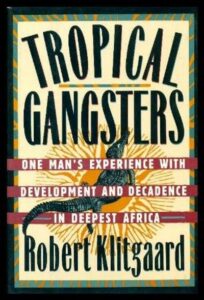
Author: Robert Klitgaard
Year: 1990
Publisher: Basic Books
Topics: International Development, Corruption, Africa, Memoir, Equatorial Guinea
About This Book
Tropical Gangsters takes you beyond the slogans and ideologies of international development to the complexities, absurdities, and possibilities of one of the poorest places on the planet.
Robert Klitgaard spent two and a half years in Equatorial Guinea in charge of a multimillion-dollar economic rehabilitation program. What he found was lethargy, corruption, and adventurism — occasionally leavened with humor and good will. This gripping memoir blends personal reminiscence with economic analysis, telling how he wrestled with corrupt states, cynical cultures, and the gangsters who ran them.
Along the way, Klitgaard fought for the human rights of a co-worker arrested and tortured by the government, confronted the nation’s president, and searched the coastline for surfing spots. A landmark in the literature of international development — named one of the New York Times Books of the Century.
Praise
“Not often will you meet a book on third-world development that is also painfully revealing, warm, bitter, funny, sad, engagingly autobiographical and about Equatorial Guinea. Here is one.”
The Economist
“Tropical Gangsters is a wonderfully entertaining and instructive book. Robert Klitgaard manages to be clear-headed about everything that is wrong with his beloved Equatorial Guinea, and by extension many other tropical trouble spots, without ever losing his sense of warmth and respect for the people he dealt with there. This is a very useful complement to any study of why nations do and do not develop.”
James Fallows, The Atlantic Monthly.
“This splendd book has been compared with the writings of V.S. Naipaul and Joseph Conrad, and John Updike’s The Coup; to me it recalls Evelyn Waugh’s Black Mischief, except that it is all true and written by an economist with a cool head and a warm heart. Never before has economic analysis been presented in a more vivd, witty and (at least for some) winning way.”
Paul Streeten, Director, World Development Insitute
Related Work
Related themes: Anti-Corruption & Integrity | International Development
Related books: Tropical Gangsters II | Corrupt Cities | Controlling Corruption